Article: How I Capture a Tone (Without Giving Everything Away)
How I Capture a Tone (Without Giving Everything Away)
I'll be honest right out of the gate: I'm an approximate engineer.
Not surgical. Not ultra-precise. There are things in audio that are right or wrong, on or off, working or not, and I can do those. Phase is flipped or it isn't. The cable works or it doesn't.
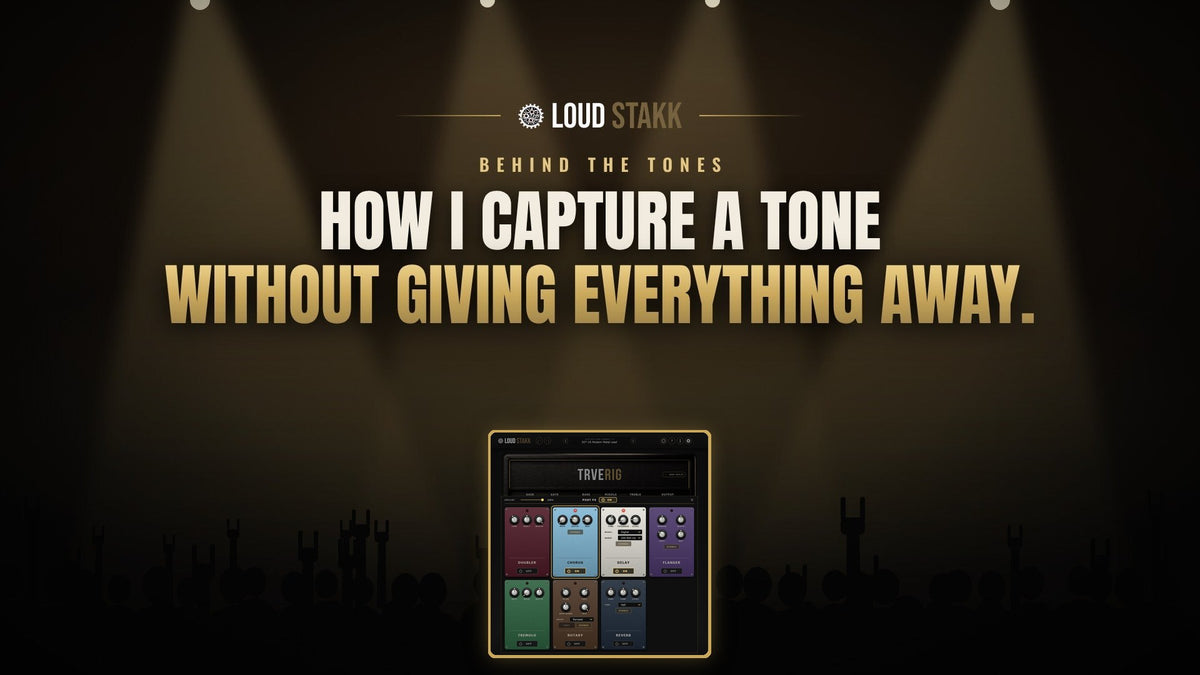
Tone isn't one of those things. Tone isn't black and white. It's approximate. Some people call it feel. Some people call it something else. Either way, it's the part of building TRVE Rig that I get asked about the most and can explain the least. So here's my best attempt, minus the bits I either can't put into words or would rather keep.

The real foundation is thirty years of listening
If you want to know where my tones come from, it isn't a mic locker. It's 30+ years of Heavy Music consumption. Listening. Visualizing. Taking mental notes.
I've probably spent more time listening than placing mics, dialing knobs and tweaking settings combined. That's the real foundation. Everything else sits on top of it.
Here's an example. Put on Mötley Crüe's Dr. Feelgood, Metallica's Black Album and Bon Jovi's Keep the Faith, back to back. That's basically the same drum sound. Not identical, but carved from the same log. And once you hear that, you can't unhear it.
That's the kind of listening I mean. Not "this sounds good", but "I know what this is made of, and I've heard it before." If you want one studio tip out of this whole post, it's that one: listen to records like that. It's free, and it's the part nobody can sell you.

Two fingers off the cloth, aimed center-ish
So what actually happens when it's time to capture? Less than you'd think. I don't overthink it.
The mic goes up. Roughly two fingers off the cloth, aimed center-ish. That's it. That's the secret technique. Or actually, put it on a T-shirt and send me a slice of the pie.
The part I can't explain happens before any of that. By the time the mic goes up, the tone already exists in my head. I know what the cab should be and what the amp should be. How do I know? I don't fully know. I know that I don't know that I know. Inception wormhole forming.
And I can't really teach it. The gear that's available just ends up translating what I'm already hearing internally. Which is a very fancy way of saying the knobs work for my ears, not the other way around.
EQ is boring
Yes, there's EQ. Boost something, cut something. But if I bypass it, the tone doesn't change that much.
EQ is boring. I avoid it until I absolutely have to use it.
That's worth trying on your own mixes, by the way. Bypass the EQ on your guitar bus and be honest about how much actually changes. If the answer is "not much", the tone was already there, or it never was, and no amount of boosting and cutting was going to decide that for you.
Where it fights back
None of this means it always goes smoothly. Even with Neural Amp Modeler, which honestly is the best capture process we've got right now, some tones fight you the whole way through. And it got even better with A2, which we are now using for Core Library 2.0.
Extremely high gain. There's technically no limit to gain. In reality you're limited by noise. Not tone, not gear: noise. When you're capturing, you can't just throw a gate in there and fix it later. So you hit a ceiling where the pedal starts feeding back, the amp starts losing control and the capture gets ruined. If some chainsaw-style tones feel a bit tame, that's why. That's the max before it falls apart.

Complex fuzz and power amp whoomp. On some older captures, everything was recorded LOUD. Which sounds like a good idea until it isn't. When you push fuzz, power amp saturation and complex gain structures, things don't always get bigger. Sometimes they get smaller. Less defined. Less usable. It's a balancing act between chaos and control.
Combos. This one isn't even about tone, it's workflow. With a combo, the amp and the sound are in the room, so to actually hear it properly you're walking back and forth to the control room. Great for getting your steps in and committing faster. But a lot of combos would sound even better split into head and cab setups.
From amp + IR to full rig captures
This is the big one. The Core Library in TRVE Rig is built on an amp + IR workflow. The TRX Expansions are full rig captures.
And that shift means more beef (call Wendy's, we found it), more cohesion and a more finished feel. Same ears, same approximate engineer, different way of getting the sound out of the room and into the plugin.
Kvlt Tones TRX. For when you need a nasty tone.
A full rig capture in practice: the Grindsaw Toothgain TRX walkthrough.
The point
There's no magic chain. No secret setting. It starts with hearing it first. Everything else just gets you there.
Which brings me to the honest part. No one's reached out about making a tone pack yet. If you've got a rig you're proud of, send me an Instagram DM and let's immortalize it. And if you just want to hear what the approximate engineer has captured so far, the expansions are below. Click one, or don't, and go listen to Dr. Feelgood instead. Both count as ear training.


-Ron D.Rock / Loudstakk